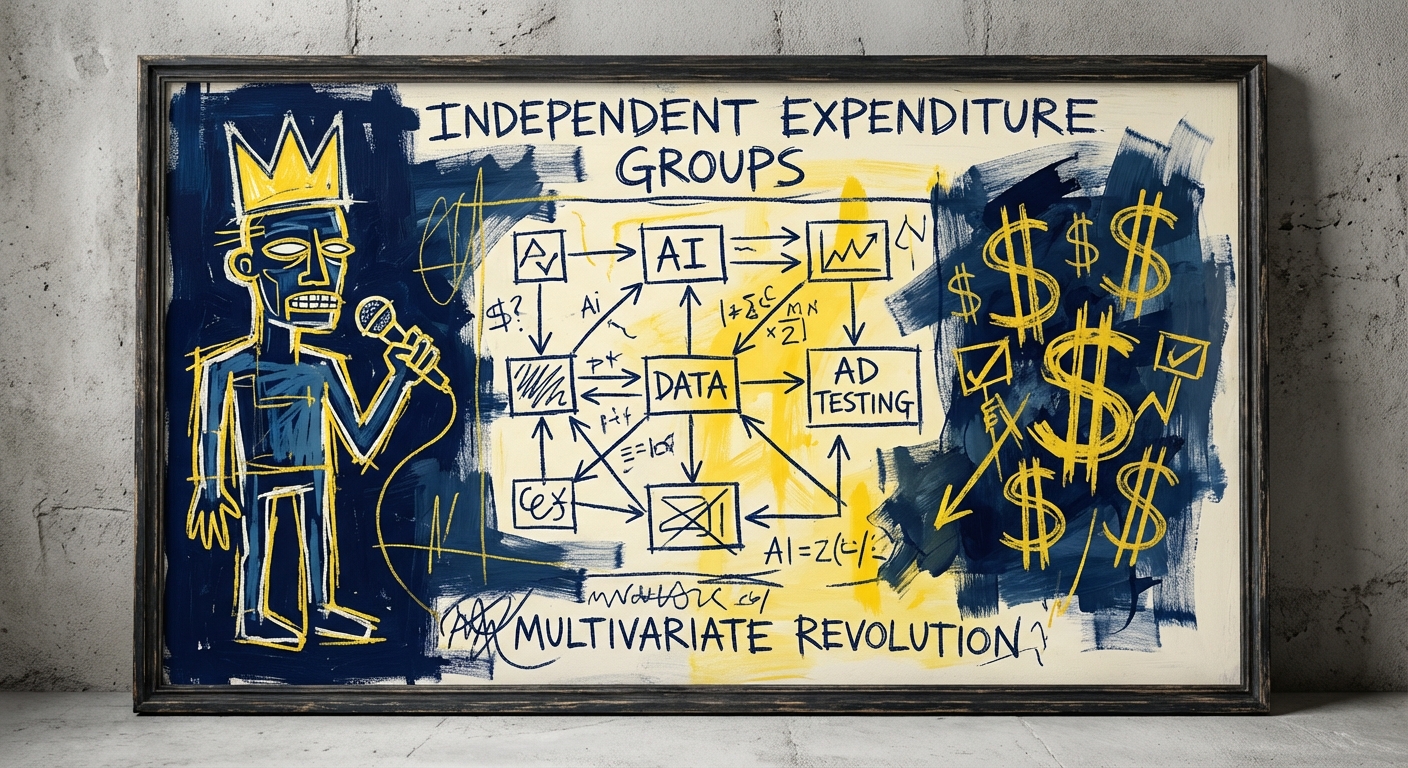

Multivariate ad testing AI for Independent Expenditure groups is no longer a luxury reserved for top-tier presidential campaigns; it is a tactical necessity for securing down-ballot victories against well-funded GOP opponents. In the modern political landscape, Independent Expenditure (IE) entities—ranging from Progressive Super PACs to Union coalitions—must operate with speed and precision, often without the ability to coordinate directly with the candidate’s campaign. This isolation requires a data-driven approach to creative strategy that removes guesswork. By leveraging artificial intelligence to test hundreds of ad variations simultaneously, IEs can identify the specific messaging hooks that drive voter mobilization and fundraising efficiency. Whether you are fighting for Reproductive Freedom or defending labor rights, the ability to iterate on creative assets in real-time allows Democratic operatives to maximize every dollar of their media buy. This guide explores how to implement these systems effectively, ensuring your war chest translates directly into winning margins on Election Day.
The fundamental challenge for any Independent Expenditure group is the disconnect between resource allocation and verified impact. Historically, political consultants relied on A/B testing—pitting one headline against another—to determine ad performance. While useful, this linear method is too slow for the rapid response nature of today’s news cycle. The MAGA ecosystem thrives on flooding the zone with content, and to counter this, Democratic allies must adopt a more robust infrastructure. This is where the strategic application of multivariate ad testing AI becomes critical. Unlike simple A/B tests, multivariate analysis allows you to test multiple variables—images, headlines, calls to action (CTAs), and body copy—in thousands of combinations simultaneously. For an IE, this means you can determine if a message about ‘protecting IVF’ resonates better with suburban women when paired with a somber image or a defiant one, all within hours of launch. This technology moves beyond gut instinct, providing hard data on voter sentiment. In high-stakes Senate races or tight House districts, where margins are razor-thin, the efficiency gained here is game-changing. It allows you to pivot resources away from underperforming creatives immediately, ensuring that your media burn rate is efficient and that your messaging punches through the noise of disinformation.
The core strategic value of integrating AI into your ad stack is the ability to scale creative production without exploding your overhead costs. Tools emerging in the political tech space, such as Battleground AI, are specifically tailored for progressive candidates and causes. They allow for the rapid generation of text-based ads for search, social, and programmatic platforms. For example, recent data indicates that smaller progressive campaigns using these tools were able to run robust social ad campaigns with budgets as low as $20,000, achieving a reach that previously required a much larger creative team. By automating the creation of variations, your team can focus on high-level strategy rather than getting bogged down in resizing images or rewriting copy manualy. Furthermore, this technology offers a significant advantage in analyzing voter sentiment. General market tools like AdCreative.ai or AdSkate use machine learning to break down why an ad is working—is it the color palette, the emotional tone of the keyword, or the specific policy mention? For a Democratic IE, understanding these nuances is vital. If the data shows that ‘corporate greed’ performs better than ‘inflation’ in a specific zip code, AI multivariate testing will surface that insight faster than a human analyst could. This allows for hyper-personalized messaging that speaks directly to the anxieties and hopes of the electorate, countering the broad, fear-based strokes often used by the opposition.
Implementing a robust testing framework requires selecting the right tools and integrating them into your existing media buying infrastructure. While general platforms like Braze offer multivariate testing, political-specific nuances matter. We recommend looking at platforms that understand the guardrails of political speech. Battleground AI, for instance, offers features like editable mockups and approval links that streamline the workflow between your digital agency and the IE’s legal compliance team. This is critical for maintaining strict separation from the candidate while ensuring all copy remains compliant with FEC regulations. To execute this tactically, your workflow should start with data ingestion. Although direct integrations with NGP VAN or ActBlue are not always native to these AI creative tools, most allow for the ingestion of voter data or Meta user data to define audience segments. Once your audience is defined—perhaps ‘Persuadable Union Households’—you use the AI to generate 50 to 100 variations of your core message. The AI might test a ‘Donate Now’ button against a ‘Join the Fight’ button, paired with five different headlines regarding healthcare costs. The system then automatically allocates budget to the winning combinations while pausing the losers. This ‘survival of the fittest’ approach to ad creative ensures that by the time you scale up your spend for the Get Out The Vote (GOTV) push, you are only backing ads that have statistically proven their ability to convert.
While the promise of AI is immense, the risks of improper implementation can be disastrous for a Democratic organization. The first and most critical mistake is the ‘set it and forget it’ mentality. AI models can hallucinate or generate copy that is tonally deaf to the current political climate. There is a risk of over-reliance on AI-generated copy that lacks the human touch required for empathetic political storytelling. Every winning variation must be reviewed by a seasoned strategist to ensure it aligns with the values of the Democratic party and does not inadvertently use language that could alienate key voting blocs. The second mistake is failing to account for platform-specific nuances. An ad that works on Facebook often fails on CTV (Connected TV). While tools like Admozart specialize in programmatic creative testing, you must ensure that your multivariate strategy accounts for the medium. Finally, there is the ethical risk. As Democrats, we fight for truth and transparency. Using AI to generate misleading imagery or deepfakes is a tactic of the Right, not the Left. Ensure your AI tools are used for optimization and scaling, not for deception. Voter trust is fragile; once lost, it is nearly impossible to regain.
Before you launch your next multivariate campaign, ensure your team has ticked these boxes to protect your organization and maximize impact: – **Compliance Review:** Have all AI-generated templates been cleared by legal for disclaimer placement and independent expenditure language? – **Human-in-the-Loop Protocol:** Is there a designated human editor responsible for final approval of all AI-generated copy variations? – **Data Sanitation:** Are you ensuring that no sensitive voter PII (Personally Identifiable Information) is being fed into public AI models? – **Platform Diversity:** Are you testing variations across search, social, and pre-roll, or limiting yourself to just one channel? – **Kill-Switch Logic:** Do you have clear parameters set for when to kill an underperforming ad to prevent wasted burn rate?
The Republican machine is well-funded, disciplined, and relentless. To defeat them, Independent Expenditure groups cannot rely on hope or outdated strategies; you need superior logistics and cutting-edge infrastructure. This is where Sutton & Smart separates itself from the pack. We provide the full-stack infrastructure required to win, including **Democratic Media Buying** and **Rapid Response Digital Ads** powered by the latest multivariate testing protocols. We don’t just place ads; we deploy **Anti-Disinformation Units** to counter GOP narratives in real-time, ensuring your message survives the digital crossfire. From **Union-Printed** direct mail to high-level digital strategy, we provide the muscle that powers the Blue Wave. Stop guessing what voters want and start delivering the message that wins the seat.
Contact Sutton & Smart today to upgrade your campaign infrastructure and secure the victory.
Ready to launch a winning campaign? Let Sutton & Smart political consulting help you maximize your budget, raise a bigger war chest, and reach more voters.
An expert in management, strategy, and field organizing, Jon has been a frequent commentator in national publications.
AutoAuthor | Partner
Not necessarily. While enterprise tools exist, newer political startups like Battleground AI are making these features accessible. We have seen campaigns execute effective multivariate tests with media budgets around $20,000, significantly lowering the barrier to entry compared to traditional firm retainers.
No. AI is a force multiplier, not a replacement. It can generate variations and analyze data, but it cannot replace the strategic vision, emotional intelligence, and political instincts of a human consultant. You still need experienced hands to guide the prompt engineering and final approvals.
A/B testing compares two versions of an ad to see which wins. Multivariate testing uses AI to compare multiple variables (headline, image, button, description) in hundreds of combinations simultaneously to find the exact mix of elements that drives the highest performance.
This article is provided for educational and informational purposes only and does not constitute legal, financial, or tax advice. Political campaign laws, FEC regulations, voter-file handling rules, and platform policies (Meta, Google, etc.) are subject to frequent change. State-level laws governing the use, storage, and transmission of voter files or personally identifiable political data vary significantly and may impose strict limitations on third-party uploads, data matching, or cross-platform activation. Always consult your campaign’s General Counsel, Compliance Treasurer, or state party data governance office before making strategic, legal, or financial decisions related to voter data. Parts of this article may have been created, drafted, or refined using artificial intelligence tools. AI systems can produce errors or outdated information, so all content should be independently verified before use in any official campaign capacity. Sutton & Smart is an independent political consulting firm. Unless explicitly stated, we are not affiliated with, endorsed by, or sponsored by any third-party platforms mentioned in this content, including but not limited to NGP VAN, ActBlue, Meta (Facebook/Instagram), Google, Hyros, or Vibe.co. All trademarks and brand names belong to their respective owners and are used solely for descriptive and educational purposes.
https://digiday.com/media-buying/how-ai-shaped-the-2024-election-from-ad-strategy-to-voter-sentiment-analysis/
https://admozart.com/ai-powered-creative-testing-in-programmatic-campaigns/
https://www.adcreative.ai/post/how-multivariate-testing-by-ai-makes-ad-creatives-that-convert
At Sutton & Smart, we don’t just help campaigns—we build movements. With proven strategies and a relentless commitment to success, we empower leaders to create lasting change at every level.
Copyright © 2025 Sutton & Smart. All Rights Reserved. Site by Flashcat.io
By submitting this form, you consent to allow Sutton & Smart to store and process your information in accordance with our Privacy Policy. You also consent to receive communications via email, phone, or SMS from Sutton & Smart regarding our services, including promotional offers and inquiries. These communications may be generated using automated technology, such as AI-powered autodialers, pre-recorded messages, and SMS notifications. Your information will be used strictly for business purposes, and you may opt out of these communications at any time. By clicking submit, you acknowledge that the effectiveness of Sutton & Smart’s political consulting strategies and outcomes may vary based on numerous factors outside our control, and no specific results or timelines are guaranteed. You also confirm that you have read and agree to our Terms of Service.
By submitting this form, you consent to allow Sutton & Smart to store and process your information in accordance with our Privacy Policy. You also consent to receive communications via email, phone, or SMS from Sutton & Smart regarding our services, including promotional offers and inquiries. These communications may be generated using automated technology, such as AI-powered autodialers, pre-recorded messages, and SMS notifications. Your information will be used strictly for business purposes, and you may opt out of these communications at any time. By clicking submit, you acknowledge that the effectiveness of Sutton & Smart’s political consulting strategies and outcomes may vary based on numerous factors outside our control, and no specific results or timelines are guaranteed. You also confirm that you have read and agree to our Terms of Service.