Cost of Programmatic Direct Mail vs. Traditional Drops
The Cost of Programmatic Direct Mail vs. Traditional Drops is one of the most critical budget debates we encounter in modern Democratic campaigns. With the Republican war chest growing every election cycle, we cannot afford to burn precious cash on mailers that go straight into the recycling bin without a second glance. To protect democracy and secure a Blue Wave, campaign managers must understand the economic trade-offs between the broad reach of “spray-and-pray” bulk drops and the surgical precision of data-driven programmatic mail. While traditional methods offer lower upfront unit costs, the inefficiency of mailing non-persuadable voters often inflates the real cost per vote. This guide will help you navigate these pricing structures so you can allocate your resources where they will actually move the needle.
Analyzing the Cost of Programmatic Direct Mail vs. Traditional Drops for Democrats
Before dissecting the specific price tags, you must understand the criteria that drive political mail economics. In the Democratic ecosystem, we are not just looking for the cheapest sheet of paper; we are looking for the most efficient way to mobilize a vote or secure a donation. When evaluating your options, you must consider three main factors: postage class, production complexity, and data hygiene. Postage rates have risen significantly, with First Class now exceeding $0.60 per piece, while nonprofit or political bulk rates hover between $0.30 and $0.45. Additionally, for any serious Democratic campaign, you must account for the cost of union labor. Ensuring your mail piece carries a Union Bug is non-negotiable for maintaining support from labor coalitions, which can slightly adjust your production costs compared to non-union commercial shops. Finally, the hidden cost of waste—paying to mail a registered Republican or a voter who moved three years ago—must be factored into your ROI calculation.
The Economics of Traditional Political Bulk Drops
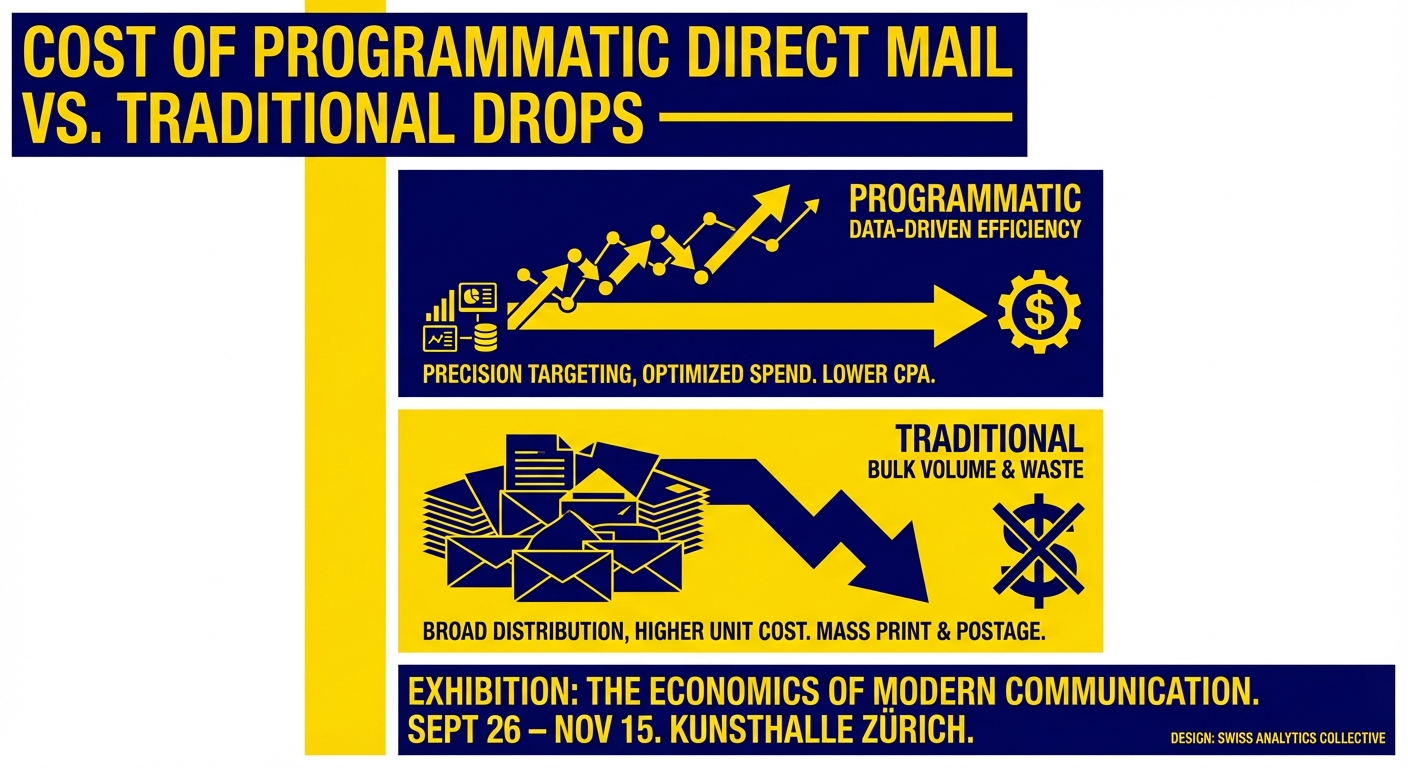
Traditional direct mail, often called a “drop,” relies on economies of scale. By printing 10,000 to 50,000 identical pieces, you drive down the unit cost significantly. In the current market, a standard 6×11 political postcard sent via bulk rate typically lands in the all-in range of $0.50 to $1.00 per piece. This price includes printing, mail shop services, and postage. The primary advantage here is volume; you can blanket an entire district or a specific zip code to build name recognition or inform voters about a ballot initiative. However, the downside is the lack of precision. When you execute a carrier route saturation mailing to save on postage, you are inevitably paying to put your progressive message in the hands of MAGA loyalists who will never vote for you. While the cost per piece is low, the cost per *persuadable contact* can be deceptively high because your denominator includes thousands of wasted impressions.
Breaking Down Programmatic Direct Mail Pricing
Programmatic Direct Mail (PDM) operates on a completely different financial model. Instead of printing a massive batch at once, PDM uses digital triggers—such as a voter visiting your donation page, abandoning a sign-up form, or being tagged in NGP VAN as a “likely supporter”—to send individual pieces automatically. Because these are often printed on demand or in smaller daily batches, the per-piece cost is higher, generally ranging from $0.75 to over $2.00 depending on the format and level of personalization. This premium pays for speed and relevance. For example, if a potential donor abandons an ActBlue contribution form, a physical reminder can arrive in their mailbox within days while the intent is still fresh. While the sticker price scares some budget directors, the elimination of waste is the counter-argument. You are paying a premium to ensure you only mail people who have already demonstrated high intent or engagement.
The ROI Verdict: Cost Per Piece vs. Cost Per Vote
When you strictly compare the Cost of Programmatic Direct Mail vs. Traditional Drops on a spreadsheet, traditional looks cheaper. But winning campaigns do not run on spreadsheets; they run on votes. The true metric is Cost Per Desired Action (CPDA). Traditional drops are excellent for top-of-funnel awareness where the goal is simply for voters to know the candidate’s name exists. However, for persuasion and fundraising, programmatic often wins on ROI. If you spend $10,000 on a traditional drop that yields a 0.5% response rate, your cost per acquisition is massive. Conversely, spending that same $10,000 on a higher-priced programmatic campaign that targets only voters who engaged with your digital ads might yield a 5% conversion rate. By integrating your mail strategy with your digital stack, specifically targeting audiences who have already seen your CTV spots or display ads, you create a “surround sound” effect that drastically lowers the cost per vote, justifying the higher unit price of the mailer itself.
When to Deploy Each Strategy to Defeat the GOP
To defeat the Republican machine, you need a hybrid approach. Use traditional bulk drops for your foundational “Introduction” and “Get Out The Vote” (GOTV) phases where you need to reach every likely Democratic voter in the district. This is where the low unit cost maximizes your budget. Pivot to programmatic direct mail for specific, high-value targets: fundraising chasers, ballot cure instructions for specific voters, and persuasion pieces for swing voters who have engaged with your content online. Do not use programmatic for cold acquisition; it is too expensive. Use it as a closing tool. By layering these tactics, you ensure that your base gets the volume they need while your swing targets get the personalized attention required to flip their vote.
The Sutton & Smart Difference: Full-Stack Democratic Mail Infrastructure
To beat well-funded Republican opponents, you need more than just a printer; you need a strategic partner who understands the data behind the ink. At Sutton & Smart, we specialize in Union-Printed Direct Mail that carries the label your coalition demands, combined with the sophistication of modern data targeting. Whether you need Emergency 48-Hour Production to counter a late-breaking GOP attack ad or a complex slate mailer strategy that integrates with your digital buy, we ensure your message lands in the right mailboxes. We don’t just send mail; we execute the logistics that power the Blue Wave, ensuring your budget delivers votes, not just paper.
Ready to Secure the Vote?
Contact Sutton & Smart today to upgrade your mail strategy with union-backed precision.
Ready to launch a winning campaign? Let Sutton & Smart political consulting help you maximize your budget, raise a bigger war chest, and reach more voters.
Jon Sutton
An expert in management, strategy, and field organizing, Jon has been a frequent commentator in national publications.
Does programmatic direct mail integrate with NGP VAN?
Yes, most sophisticated political vendors can sync NGP VAN lists or CRM tags to programmatic mail workflows, allowing field data (like canvass results) to trigger mailers.
Is the Union Bug available on programmatic mail?
It depends on the vendor. While many commercial PDM platforms do not offer it, specialized Democratic firms ensure that even on-demand pieces are union-printed.
Can we target ActBlue donors with programmatic mail?
Directly, usually no, but indirectly, yes. You can export ActBlue donor data into your CRM/VAN and use that updated list to trigger retention or upgrade mailers.
This article is provided for educational and informational purposes only and does not constitute legal, financial, or tax advice. Political campaign laws, FEC regulations, voter-file handling rules, and platform policies (Meta, Google, etc.) are subject to frequent change. State-level laws governing the use, storage, and transmission of voter files or personally identifiable political data vary significantly and may impose strict limitations on third-party uploads, data matching, or cross-platform activation. Always consult your campaign’s General Counsel, Compliance Treasurer, or state party data governance office before making strategic, legal, or financial decisions related to voter data. This material is provided for general guidance only and should be independently verified before use in any official campaign capacity. Sutton & Smart is an independent political consulting firm. Unless explicitly stated, we are not affiliated with, endorsed by, or sponsored by any third-party platforms mentioned in this content, including but not limited to NGP VAN, ActBlue, Meta (Facebook/Instagram), Google, Hyros, or Vibe.co. All trademarks and brand names belong to their respective owners and are used solely for descriptive and educational purposes.
Get more of our political coverage in your Google results:
Scroll to Top
View All Brands
Fill out the form to view all Sutton & Smart Brands.
By submitting this form, you consent to allow Sutton & Smart to store and process your information in accordance with our
Privacy Policy.
You also consent to receive communications via email, phone, or SMS from Sutton & Smart regarding our services, including promotional offers and inquiries.
These communications may be generated using automated technology, such as AI-powered autodialers, pre-recorded messages, and SMS notifications.
Your information will be used strictly for business purposes, and you may opt out of these communications at any time.
By clicking submit, you acknowledge that the effectiveness of Sutton & Smart’s political consulting strategies and outcomes may vary based on numerous factors outside our control, and no specific results or timelines are guaranteed.
You also confirm that you have read and agree to our
Terms of Service.
Work With Us
Fill out the form below to speak with someone from our team.
By submitting this form, you consent to allow Sutton & Smart to store and process your information in accordance with our
Privacy Policy.
You also consent to receive communications via email, phone, or SMS from Sutton & Smart regarding our services, including promotional offers and inquiries.
These communications may be generated using automated technology, such as AI-powered autodialers, pre-recorded messages, and SMS notifications.
Your information will be used strictly for business purposes, and you may opt out of these communications at any time.
By clicking submit, you acknowledge that the effectiveness of Sutton & Smart’s political consulting strategies and outcomes may vary based on numerous factors outside our control, and no specific results or timelines are guaranteed.
You also confirm that you have read and agree to our
Terms of Service.