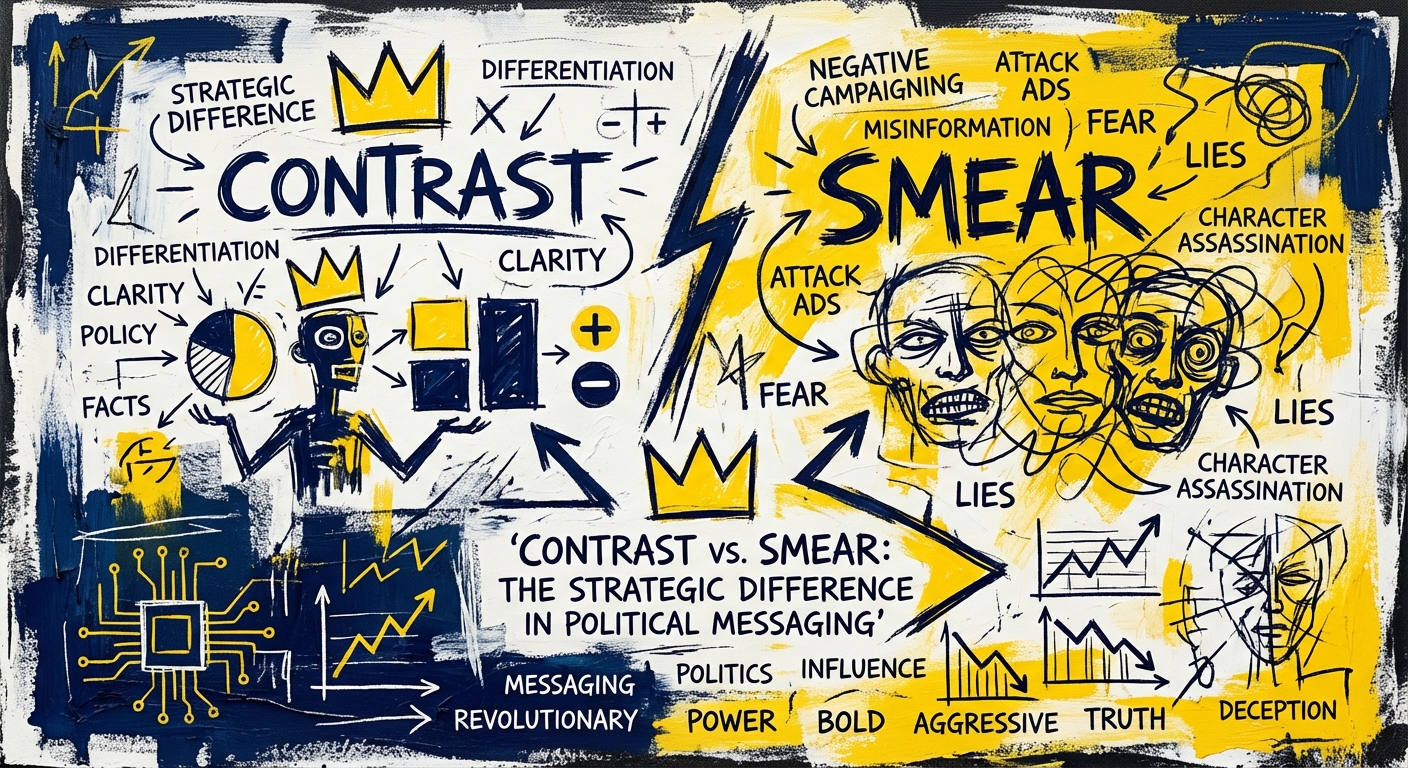
Contrast vs. Smear: The Strategic Difference in Political Messaging
Contrast vs. Smear: The Strategic Difference in Political Messaging defines the boundary between a hard-hitting, winning campaign and a desperate one that alienates voters. In the current era of hyper-partisan politics, Democratic candidates often struggle with how aggressive to be against Republican opponents who have no qualms about spreading disinformation. You might feel the pressure to fight fire with fire, especially when facing MAGA extremism, but there is a distinct tactical line you must respect to keep the moral high ground while still mobilizing your base. Understanding this nuance is not just about ethics; it is about math and voter persuasion efficiency. This guide breaks down how to weaponize the truth without resorting to the dirty tricks that characterize the opposition.
Mastering Contrast vs. Smear: The Strategic Difference in Political Messaging
Before approving your next TV spot or direct mail piece, you need a framework to evaluate its potential impact. The debate usually comes down to three factors: believability, backlash risk, and base mobilization. First, believability is currency. Voters are increasingly skeptical of political advertising, and a claim that feels like a smear—unsubstantiated or personally vicious—can permanently damage your credibility. Second, consider the backlash. While the GOP base often rewards aggressive tacticians, the Democratic coalition (including suburban women and independent swing voters) tends to punish candidates who appear nasty or untruthful. Finally, you must weigh mobilization against persuasion. While fear-based smear campaigns can spike turnout among hardliners, they often depress the moderate vote you need to secure a 51 percent majority. Smart strategy involves threading this needle carefully.
The Power of Contrast Messaging: Winning on the Record
Contrast messaging is the gold standard for Democratic campaigns that want to be tough but fair. Unlike personal attacks, contrast ads focus on a comparative analysis of records, policy stances, and past statements. For example, highlighting that your opponent voted to cut reproductive healthcare access while you voted to codify it is a contrast, not a smear. It respects the voter’s intelligence by presenting a clear choice based on facts. The primary advantage here is sustainability; contrast messages rarely generate the kind of media blowback that forces a campaign to apologize. Tools like message mapping, utilized by firms such as Cygnal, can help you scientifically test these comparatives to see which specific policy differences move numbers the most. By focusing on aspect framing—how you grammatically present an opponent’s past actions—you can guide voters to negative inferences without ever crossing the line into falsehoods.
The Trap of Smear Tactics: Why It Backfires on Democrats
Smear tactics operate in the gutter, relying on distortion, rumors, and often outright fabrication. Common techniques include astroturfing (fake grassroots movements), selective editing of video clips to alter context, and the use of bots to spread disinformation on social platforms. While these methods are unfortunately common in the Republican playbook, they pose a significant danger to Democratic candidates. A smear campaign attacks the person rather than the policy, often using innuendo about private lives or manufactured scandals. The cons heavily outweigh the pros for our side. When a Democrat is caught in a smear, it reinforces the both sides are the same narrative that suppresses youth turnout and alienates the moral center of the electorate. Furthermore, in the age of rapid fact-checking, a debunked smear can become a stronger weapon for your opponent, who will use it to paint themselves as a victim of the liberal media machine.
Navigating the Gray Zone: When Negative Ads are Necessary
It is crucial not to confuse negative campaigning with smearing. You can and should run negative ads. The distinction lies in the veracity and the target. A negative ad that ruthlessly exposes your opponent’s attendance record or their ties to corporate lobbyists is a strategic necessity in a close race. This brings us back to Contrast vs. Smear: The Strategic Difference in Political Messaging. The strategic sweet spot is Clean Aggression. This means using the toughest possible language that is still 100 percent verifiable. Research suggests that while attack ads are powerful motivators for anxiety and attention, they must be framed as a defense of the community’s values rather than a personal vendetta. If you cannot cite a source for the claim in small print at the bottom of the screen, it is likely a smear, and it belongs in the trash, not on the airwaves.
The Verdict: Building a Winning Coalition with Clean Aggression
To win in November, you need a communications strategy that is aggressive but disciplined. Avoid the temptation to mirror the chaotic tactics of the MAGA movement. Instead, rely on data-driven contrast. Before launching an attack, run it through a rigorous checklist: Is it true? Is it relevant to the office? Can it be sourced? Does it draw a clear policy distinction? If the answer to these is yes, you are running a contrast campaign that will withstand scrutiny. If you find yourself relying on rumors, out-of-context clips, or personal insults regarding family or appearance, you have drifted into smear territory. Stick to the issues that matter—healthcare, democracy, and economic fairness—and let the stark differences between you and your opponent do the heavy lifting.
The Sutton & Smart Difference: Strategic Precision
Defeating a well-funded Republican incumbent requires more than just good intentions; it requires a war room that understands the nuances of modern political warfare. At Sutton & Smart, we provide the General Consulting and high-level strategy necessary to navigate these treacherous waters. We do not just guess what works; we use data modeling and Democratic Media Buying strategies to deliver sharp, effective contrast messages to the exact voters who need to see them. Furthermore, our Anti-Disinformation Units are equipped to detect and counter GOP smear campaigns against you in real-time, ensuring that lies do not become truth through repetition. We build the full-stack infrastructure—from polling to rapid response—that turns a fragile lead into a decisive victory.
Ready to Win?
Contact Sutton & Smart today to secure the high-level strategy and media infrastructure your campaign needs to defeat the opposition.
Ready to launch a winning campaign? Let Sutton & Smart political consulting help you maximize your budget, raise a bigger war chest, and reach more voters.
Jon Sutton
An expert in management, strategy, and field organizing, Jon has been a frequent commentator in national publications.
What is the main difference between contrast and smear ads?
Contrast ads compare factual records and policies to highlight differences, while smear ads rely on personal attacks, distortions, or lies to damage character.
Do negative ads work better than positive ones?
Negative ads are often more effective at capturing attention and mobilizing the base through anxiety, but they carry a higher risk of backlash if not factually grounded.
Is it ethical for Democrats to use negative campaigning?
Yes, provided the campaign uses contrast messaging based on facts. Pointing out an opponent's harmful voting record is a duty to the electorate, distinct from unethical smearing.
This article is provided for educational and informational purposes only and does not constitute legal, financial, or tax advice. Political campaign laws, FEC regulations, voter-file handling rules, and platform policies (Meta, Google, etc.) are subject to frequent change. State-level laws governing the use, storage, and transmission of voter files or personally identifiable political data vary significantly and may impose strict limitations on third-party uploads, data matching, or cross-platform activation. Always consult your campaign’s General Counsel, Compliance Treasurer, or state party data governance office before making strategic, legal, or financial decisions related to voter data. This material is provided for general guidance only and should be independently verified before use in any official campaign capacity. Sutton & Smart is an independent political consulting firm. Unless explicitly stated, we are not affiliated with, endorsed by, or sponsored by any third-party platforms mentioned in this content, including but not limited to NGP VAN, ActBlue, Meta (Facebook/Instagram), Google, Hyros, or Vibe.co. All trademarks and brand names belong to their respective owners and are used solely for descriptive and educational purposes.
Get more of our political coverage in your Google results:
Scroll to Top
View All Brands
Fill out the form to view all Sutton & Smart Brands.
By submitting this form, you consent to allow Sutton & Smart to store and process your information in accordance with our
Privacy Policy.
You also consent to receive communications via email, phone, or SMS from Sutton & Smart regarding our services, including promotional offers and inquiries.
These communications may be generated using automated technology, such as AI-powered autodialers, pre-recorded messages, and SMS notifications.
Your information will be used strictly for business purposes, and you may opt out of these communications at any time.
By clicking submit, you acknowledge that the effectiveness of Sutton & Smart’s political consulting strategies and outcomes may vary based on numerous factors outside our control, and no specific results or timelines are guaranteed.
You also confirm that you have read and agree to our
Terms of Service.
Work With Us
Fill out the form below to speak with someone from our team.
By submitting this form, you consent to allow Sutton & Smart to store and process your information in accordance with our
Privacy Policy.
You also consent to receive communications via email, phone, or SMS from Sutton & Smart regarding our services, including promotional offers and inquiries.
These communications may be generated using automated technology, such as AI-powered autodialers, pre-recorded messages, and SMS notifications.
Your information will be used strictly for business purposes, and you may opt out of these communications at any time.
By clicking submit, you acknowledge that the effectiveness of Sutton & Smart’s political consulting strategies and outcomes may vary based on numerous factors outside our control, and no specific results or timelines are guaranteed.
You also confirm that you have read and agree to our
Terms of Service.