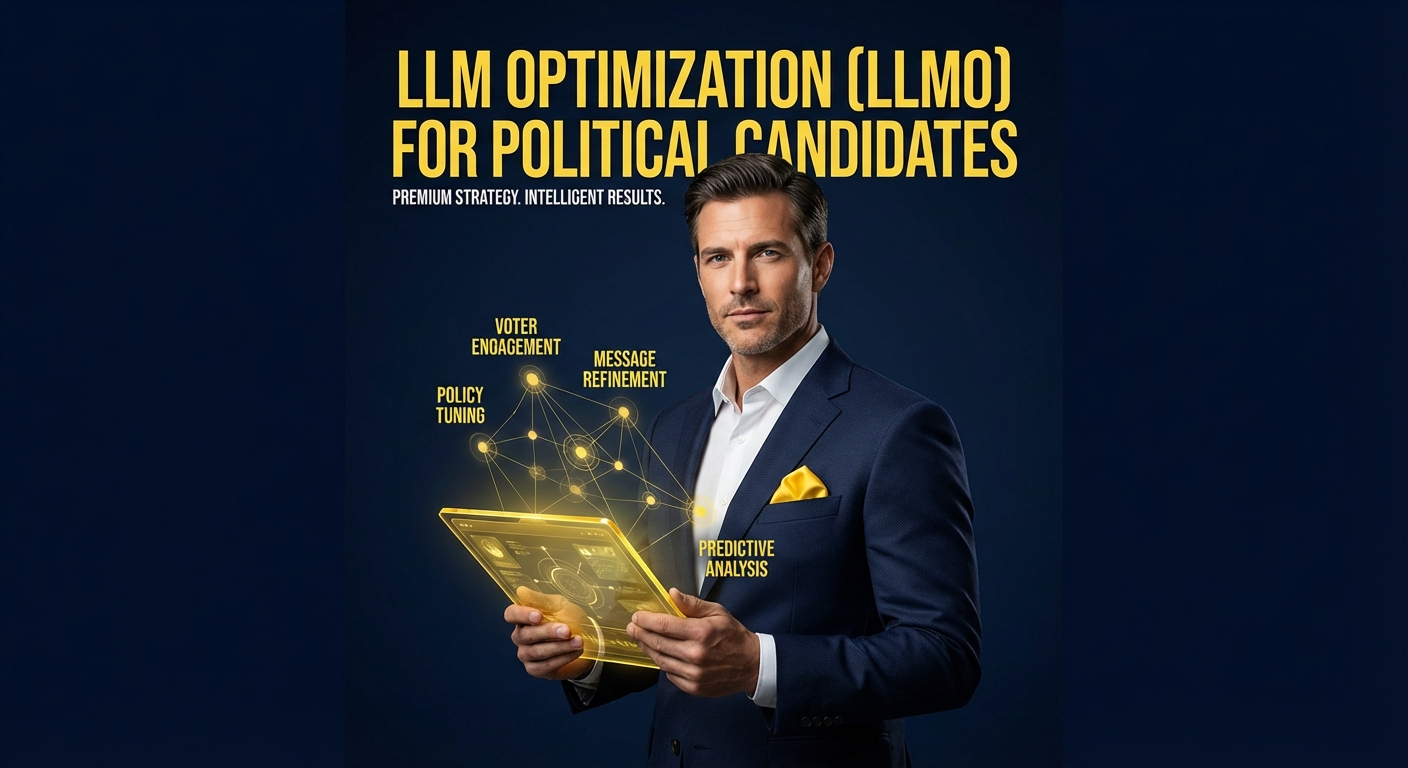
LLM Optimization (LLMO) For Political Candidates is rapidly becoming the defining variable between campaigns that scale effectively and those that drown in the noise of the digital age. As Democratic strategists, we are constantly battling a well-funded Republican ecosystem that thrives on flooding the zone with content; to compete, we must leverage large language models not just to write emails, but to fundamentally optimize our strategic throughput. However, simply buying a ChatGPT subscription is not a strategy. True optimization requires understanding the architecture of these tools to enhance persuasive messaging, simulate voter sentiment, and streamline operations without sacrificing the human connection that drives our movement. This guide explores how to integrate advanced AI workflows into your campaign infrastructure while maintaining the ethical guardrails essential to our democratic values.
LLM Optimization (LLMO) For Political Candidates: The Democratic Edge
The modern campaign environment is a pressure cooker of resource constraints, where time is often more valuable than money. LLM Optimization (LLMO) For Political Candidates addresses this bottleneck by automating the heavy lifting of content generation and data synthesis, allowing your staff to focus on high-value voter engagement. Unlike traditional software, the current landscape of AI lacks dedicated political enterprise tools; there are no ‘out-of-the-box’ LLM platforms that natively sync with NGP VAN or ActBlue. Instead, campaigns must utilize general frontier models—like GPT-4 or Claude—and optimize them for political contexts. This distinction is critical. You are not buying a political solution; you are engineering one using general-purpose tools. The goal is to move beyond basic text generation and use these models for ‘Heavy Logistics’ tasks, such as analyzing thousands of open-ended survey responses or generating hyper-localized ad variations for different zip codes. While the barrier to entry is low—often just a $20 monthly subscription—the real value lies in how you optimize prompts to reduce token costs and increase persuasion accuracy. If we want to hold the Senate and retake state legislatures, we must treat LLM adoption as a rigorous operational discipline, not a novelty.
Strategic Applications: Synthetic Polling and Persuasion
The core strategic value of LLM Optimization (LLMO) For Political Candidates lies in its ability to simulate and predict. Recent research suggests that while larger models offer diminishing returns on raw persuasive power, they excel at ‘synthetic polling’—simulating how specific demographic profiles might react to policy positions. For a Democratic candidate in a purple district, this means you can stress-test messaging on reproductive freedom or union jobs against a simulated conservative or swing-voter persona before you ever spend a dime on a focus group. This optimization allows for rapid A/B testing of narrative frames. For example, does a message about ‘corporate greed’ resonate better with rural voters than one about ‘fair taxation’? An optimized LLM workflow can generate dozens of variations and provide a preliminary analysis of their likely reception. However, this comes with a caveat: most models exhibit a slight liberal bias and perform better on Western, U.S.-centric topics. While this aligns with our values, it can be a blind spot when trying to anticipate MAGA attacks or understand deep conservative entrenchment. Strategic optimization means using these tools to identify your opponent’s strongest arguments so you can dismantle them effectively, rather than just reinforcing your own echo chamber.
Tactical Execution: Building the Workflow
Executing LLM Optimization (LLMO) For Political Candidates requires a shift from manual typing to systematic prompting. Since there are no native integrations with our voter files, your digital director must build ‘air-gapped’ workflows where anonymized voter segments are fed into the model to generate personalized content. For instance, you can take a generic platform plank on infrastructure and ask the model to rewrite it for five different personas: a union carpenter in the Rust Belt, a suburban mom concerned about safety, or a Gen Z climate activist. This level of hyper-personalization, often called ‘micro-targeting at scale,’ allows you to flood the digital space with relevant, localized content. From a cost perspective, general API access is pay-per-use. While individual queries are cheap, high-volume automated agents can rack up significant costs if not optimized. We recommend using ‘quantized’ or efficient models for drafting first versions of fundraising emails and reserving the more expensive, ‘reasoning-heavy’ models for analyzing complex opposition research or legislative text. Remember, the tool is only as good as the context you provide; feeding it specific local landmarks or recent town council decisions will yield far superior results than generic prompts.
Risks and Guardrails: Avoiding the Hallucination Trap
In our rush to innovate, we cannot ignore the risks associated with LLM Optimization (LLMO) For Political Candidates. The most dangerous pitfall is ‘hallucination’—where the AI invents facts, quotes, or voting records. In a high-stakes campaign, publishing an AI-generated lie about an opponent is not just an embarrassing gaffe; it is potential grounds for defamation and a gift to the GOP attack machine. Furthermore, data privacy is non-negotiable. Never upload raw voter lists, donor credit card info, or proprietary strategy memos into a public LLM interface. These models train on user data, and we cannot risk our internal strategy leaking into the public domain. There is also the risk of ‘persuasion ceilings.’ Research indicates that while AI can write coherent arguments, it rarely outperforms a skilled human speechwriter in deeply emotional or nuanced territory. Over-reliance on AI for your core stump speech or closing argument can leave your campaign sounding robotic and out of touch. Use LLMs to clear the brush, but let human empathy lead the way.
Pre-Launch Checklist for AI Integration
Before fully deploying LLM Optimization (LLMO) For Political Candidates across your campaign, run through this compliance and safety checklist. First, establish a ‘Human-in-the-Loop’ protocol: no AI-generated content goes live without human review. Second, audit your token budget; ensure your digital team understands the cost difference between GPT-4 and cheaper alternatives for bulk tasks. Third, verify your data hygiene; ensure staff are trained on what can and cannot be pasted into a prompt. Fourth, test for bias; specifically ask the model to critique your messaging from the perspective of your specific Republican opponent to ensure you aren’t fighting a straw man. Finally, maintain transparency. While we want to be efficient, voters value authenticity. If you are using AI to clone your voice or image (which we generally advise against for ethical reasons), disclosure is mandatory. The goal is to enhance your team’s capabilities, not to deceive the electorate.
The Sutton & Smart Difference
Hope is not a strategy, and raw data without direction is just noise. To defeat the Republican infrastructure, you need more than just a clever ChatGPT prompt; you need a battle-tested partner who understands how to weaponize technology for the win. At Sutton & Smart, we specialize in the intersection of high-level strategy and digital warfare. We don’t just advise on AI; we integrate it into our **Democratic Media Buying** and **Rapid Response Digital Ads** services, ensuring your message dominates the screen while our **Anti-Disinformation Units** neutralize GOP attacks in real-time. We combine the efficiency of machine learning with the grit of union-strong logistics. Don’t let your opponent out-innovate you. Let’s build the infrastructure that secures your seat.
Ready to Optimize Your Campaign?
Contact Sutton & Smart today to upgrade your digital infrastructure and secure the data-driven edge your campaign needs to win.
Ready to launch a winning campaign? Let Sutton & Smart political consulting help you maximize your budget, raise a bigger war chest, and reach more voters.
Jon Sutton
An expert in management, strategy, and field organizing, Jon has been a frequent commentator in national publications.
Are there specific LLM tools for Democratic campaigns?
Currently, no dedicated commercial LLM tools exist exclusively for political campaigns with features like voter file integration. Campaigns typically use general enterprise models like OpenAI's GPT-4 or Anthropic's Claude and build custom internal workflows.
How much does LLM optimization cost for a campaign?
The barrier to entry is low, with subscriptions starting around $20/month. However, extensive API usage for analyzing large datasets or generating thousands of ad variations follows a pay-per-use model that can scale up quickly.
Can LLMs replace human pollsters?
No. While 'synthetic polling' can simulate voter reactions and test messaging frames effectively, it cannot replace live polling for accurate horse-race numbers or capturing shifting ground-level sentiment.
This article is provided for educational and informational purposes only and does not constitute legal, financial, or tax advice. Political campaign laws, FEC regulations, voter-file handling rules, and platform policies (Meta, Google, etc.) are subject to frequent change. State-level laws governing the use, storage, and transmission of voter files or personally identifiable political data vary significantly and may impose strict limitations on third-party uploads, data matching, or cross-platform activation. Always consult your campaign’s General Counsel, Compliance Treasurer, or state party data governance office before making strategic, legal, or financial decisions related to voter data. This material is provided for general guidance only and should be independently verified before use in any official campaign capacity. Sutton & Smart is an independent political consulting firm. Unless explicitly stated, we are not affiliated with, endorsed by, or sponsored by any third-party platforms mentioned in this content, including but not limited to NGP VAN, ActBlue, Meta (Facebook/Instagram), Google, Hyros, or Vibe.co. All trademarks and brand names belong to their respective owners and are used solely for descriptive and educational purposes.
Get more of our political coverage in your Google results:
Scroll to Top
View All Brands
Fill out the form to view all Sutton & Smart Brands.
By submitting this form, you consent to allow Sutton & Smart to store and process your information in accordance with our
Privacy Policy.
You also consent to receive communications via email, phone, or SMS from Sutton & Smart regarding our services, including promotional offers and inquiries.
These communications may be generated using automated technology, such as AI-powered autodialers, pre-recorded messages, and SMS notifications.
Your information will be used strictly for business purposes, and you may opt out of these communications at any time.
By clicking submit, you acknowledge that the effectiveness of Sutton & Smart’s political consulting strategies and outcomes may vary based on numerous factors outside our control, and no specific results or timelines are guaranteed.
You also confirm that you have read and agree to our
Terms of Service.
Work With Us
Fill out the form below to speak with someone from our team.
By submitting this form, you consent to allow Sutton & Smart to store and process your information in accordance with our
Privacy Policy.
You also consent to receive communications via email, phone, or SMS from Sutton & Smart regarding our services, including promotional offers and inquiries.
These communications may be generated using automated technology, such as AI-powered autodialers, pre-recorded messages, and SMS notifications.
Your information will be used strictly for business purposes, and you may opt out of these communications at any time.
By clicking submit, you acknowledge that the effectiveness of Sutton & Smart’s political consulting strategies and outcomes may vary based on numerous factors outside our control, and no specific results or timelines are guaranteed.
You also confirm that you have read and agree to our
Terms of Service.