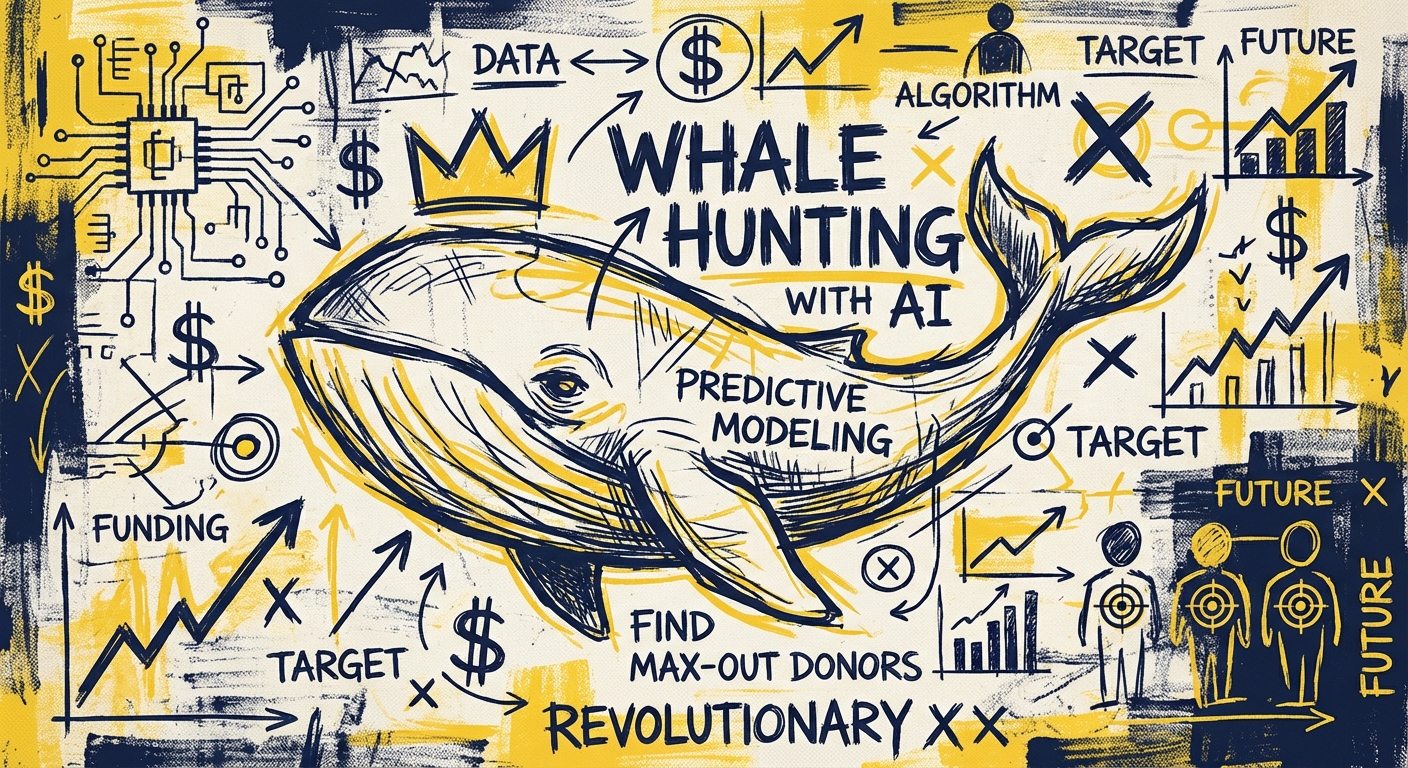
Whale Hunting with AI: Using Predictive Modeling to Find Max-Out Donors
Whale Hunting with AI: Using Predictive Modeling to Find Max-Out Donors is no longer a futuristic concept reserved for presidential committees; it is now the tactical baseline for winning competitive Democratic races at every level. In an era where the GOP machine is funded by dark money mega-donors, relying solely on rolodexes and past-cycle giving history is a recipe for being outspent and outmaneuvered. Modern finance directors know that the most valuable donors are often the ones who are not yet on your radar—the hidden progressives with high capacity who simply have not been asked the right way. By leveraging artificial intelligence and predictive analytics, we can now scan voter files and consumer data to identify these prospects with surgical precision, ensuring your candidate spends call time talking to people who can actually write the max-out check.
Modernizing Major Donor Fundraising for the Democratic Ecosystem
The traditional method of political fundraising—often called Dialing for Dollars—is notoriously inefficient. Candidates often spend 20 to 30 hours a week in a windowless room calling through a list of people who gave $500 four years ago, hoping they might upgrade. This approach burns out candidates and wastes critical campaign hours. The core problem is that past behavior, while predictive, is limited by the scope of previous asks. Just because a donor gave $250 to a City Council race does not mean they lack the capacity to give $3,300 to a Congressional race; they just haven’t been identified as a high-capacity target. Whale hunting with AI: using predictive modeling to find max-out donors solves this efficiency gap. It shifts the strategy from desperate volume calling to targeted relationship building, allowing your finance team to prioritize leads based on statistical probability rather than gut feeling.
How Predictive Modeling Transforms Donor Discovery
Predictive modeling works by layering multiple data sets to create a holistic score for every potential donor in your district or state. Vendors like Aristotle, Matchbox.io, and various NGP VAN integrations utilize machine learning algorithms that analyze hundreds of variables simultaneously. These models look at demographic markers, real estate values, consumer spending habits, and historic giving patterns across the entire Democratic ecosystem—not just your specific campaign. By synthesizing this data, the AI assigns a propensity score (how likely they are to give) and a capacity score (how much they can afford to give). This allows a campaign to separate a likely $25 grassroots donor from a likely $6,600 couple. Instead of treating every registered Democrat with a pulse as a generic prospect, you gain the ability to segment your universe into distinct tiers, focusing your most precious resource—the candidate’s time—exclusively on the whales.
Executing the Hunt: From Data to Dollars
Implementing a strategy of whale hunting with AI: using predictive modeling to find max-out donors requires a disciplined workflow. First, you must prioritize data hygiene; your predictive scores will be useless if your underlying voter file has bad phone numbers or outdated addresses. Once your data is clean, you work with a modeling vendor to score your file. The output usually integrates directly into your CRM, such as NGP VAN, appearing as new custom fields. The next step is rigorous segmentation. You should create a call list specifically for individuals with a Capacity Score in the top 5 percentile and a Propensity Score above 70. This becomes your High-Priority Call Time list. Simultaneously, you can take those with high capacity but lower propensity—perhaps people who are wealthy but not politically active—and target them with specialized events or peer-to-peer introductions from your finance committee, rather than cold calls. This tiered approach maximizes conversion rates and builds long-term donor loyalty.
Three Critical Errors in AI-Driven Fundraising
While the technology is powerful, campaigns frequently mishandle the execution. The first major error is over-reliance on the model at the expense of human intelligence. A predictive score can tell you someone is wealthy and liberal, but it cannot tell you they just lost their job or are angry at the local party chair; your finance team must still vet top-tier prospects personally. The second error is ignoring compliance limits. When targeting max-out donors, your data operations must account for who has already given to the primary or general election funds to avoid awkward and illegal over-asks. Finally, many campaigns fail to refresh their data. Wealth and political engagement are dynamic; using a model from three years ago to guide today’s fundraising strategy is a tactical failure that leaves money on the table.
Your Pre-Launch Data Checklist
Before you invest in high-level modeling, ensure your campaign is operationally ready to handle the influx of data. Start by verifying that your NGP VAN or relevant CRM is set up to accept bulk uploads of custom scores and that your finance staff knows how to build saved searches based on these fields. Confirm that you have a budget line item for data enrichment; while some party committees provide basic scores, true high-capacity modeling often requires a paid vendor engagement. Finally, establish a workflow for feedback loops. When a candidate calls a predicted whale and gets a hard no, that data point needs to be entered back into the system immediately. This ensures that your time is not wasted on the same bad lead twice and helps refine future targeting efforts.
The Sutton & Smart Difference: Full-Stack Fundraising Infrastructure
Identifying a potential major donor is only the first step; closing the deal requires a sophisticated operation that data alone cannot provide. At Sutton & Smart, we do not just hand you a spreadsheet of names; we build the machine that processes them. We specialize in ActBlue Optimization to capture low-dollar momentum while deploying a High-Dollar Bundler Strategy that leverages your AI-identified whales to bring in their own networks. From managing Joint Fundraising Committee (JFC) Compliance to scripting the perfect ask for a max-out prospect, we ensure your campaign extracts every possible dollar from the data. In a cycle where the margins are razor-thin, you need a partner who understands that superior logistics and aggressive fundraising are what ultimately protect our democracy.
Ready to Outraise the Opposition?
Contact Sutton & Smart today to build a fundraising operation that wins.
Ready to launch a winning campaign? Let Sutton & Smart political consulting help you maximize your budget, raise a bigger war chest, and reach more voters.
Jon Sutton
An expert in management, strategy, and field organizing, Jon has been a frequent commentator in national publications.
Is using consumer data for political fundraising ethical?
Yes, it is standard practice. Democratic campaigns utilize publicly available voter files, FEC records, and commercial data aggregations to ensure we are communicating with the right citizens. This efficiency is critical to competing against well-funded opposition.
Does this replace the need for a Finance Director?
Absolutely not. AI provides the roadmap, but the Finance Director drives the car. Predictive models identify who to call, but building the relationship, managing the follow-up, and closing the gift requires skilled human professionals.
How accurate are these predictive models?
Accuracy varies by vendor and data quality, but modern machine learning models are significantly more effective than manual targeting. They excel at identifying patterns that humans miss, such as finding wealthy donors in unexpected zip codes.
This article is provided for educational and informational purposes only and does not constitute legal, financial, or tax advice. Political campaign laws, FEC regulations, voter-file handling rules, and platform policies (Meta, Google, etc.) are subject to frequent change. State-level laws governing the use, storage, and transmission of voter files or personally identifiable political data vary significantly and may impose strict limitations on third-party uploads, data matching, or cross-platform activation. Always consult your campaign’s General Counsel, Compliance Treasurer, or state party data governance office before making strategic, legal, or financial decisions related to voter data. Parts of this article may have been created, drafted, or refined using artificial intelligence tools. AI systems can produce errors or outdated information, so all content should be independently verified before use in any official campaign capacity. Sutton & Smart is an independent political consulting firm. Unless explicitly stated, we are not affiliated with, endorsed by, or sponsored by any third-party platforms mentioned in this content, including but not limited to NGP VAN, ActBlue, Meta (Facebook/Instagram), Google, Hyros, or Vibe.co. All trademarks and brand names belong to their respective owners and are used solely for descriptive and educational purposes.
Fill out the form to view all Sutton & Smart Brands.
By submitting this form, you consent to allow Sutton & Smart to store and process your information in accordance with our
Privacy Policy.
You also consent to receive communications via email, phone, or SMS from Sutton & Smart regarding our services, including promotional offers and inquiries.
These communications may be generated using automated technology, such as AI-powered autodialers, pre-recorded messages, and SMS notifications.
Your information will be used strictly for business purposes, and you may opt out of these communications at any time.
By clicking submit, you acknowledge that the effectiveness of Sutton & Smart’s political consulting strategies and outcomes may vary based on numerous factors outside our control, and no specific results or timelines are guaranteed.
You also confirm that you have read and agree to our
Terms of Service.
Work With Us
Fill out the form below to speak with someone from our team.
By submitting this form, you consent to allow Sutton & Smart to store and process your information in accordance with our
Privacy Policy.
You also consent to receive communications via email, phone, or SMS from Sutton & Smart regarding our services, including promotional offers and inquiries.
These communications may be generated using automated technology, such as AI-powered autodialers, pre-recorded messages, and SMS notifications.
Your information will be used strictly for business purposes, and you may opt out of these communications at any time.
By clicking submit, you acknowledge that the effectiveness of Sutton & Smart’s political consulting strategies and outcomes may vary based on numerous factors outside our control, and no specific results or timelines are guaranteed.
You also confirm that you have read and agree to our
Terms of Service.