How to Run for U.S. Senate

How to Run for U.S. Senate: A Comprehensive Guide

Running for the United States Senate is a major political undertaking that requires immense preparation, significant resources, and a deep understanding of your state’s electorate. This guide breaks down the process into four key phases: establishing eligibility, navigating the nomination, gaining ballot access, and executing a winning campaign strategy.

A Roadmap for Running for the U.S. Senate

The United States Senate. It is frequently referred to as the “world’s greatest deliberative body.” With only 100 seats—two for every state regardless of population—a Senator wields immense influence over national policy, Supreme Court confirmations, foreign treaties, and the overall direction of the country. A single Senator can bring the legislative process to a halt.

Deciding to run for one of these six-year terms isn’t just a career pivot; it is a life-altering commitment that will test every fiber of your being. It requires extraordinary stamina, an impossibly thick skin, a deeply held vision for your state, and, frankly, an almost delusional level of self-confidence.

If you are seriously considering throwing your hat into the ring, you need to immediately move past the daydream phase and into cold, hard operational mode. This is not running for local school board or city council (though those are noble endeavors). A modern U.S. Senate race is a massive, multi-million dollar enterprise operating under intense, unforgiving national scrutiny.

Here is a practical, detailed roadmap to the realities of launching a U.S. Senate campaign.

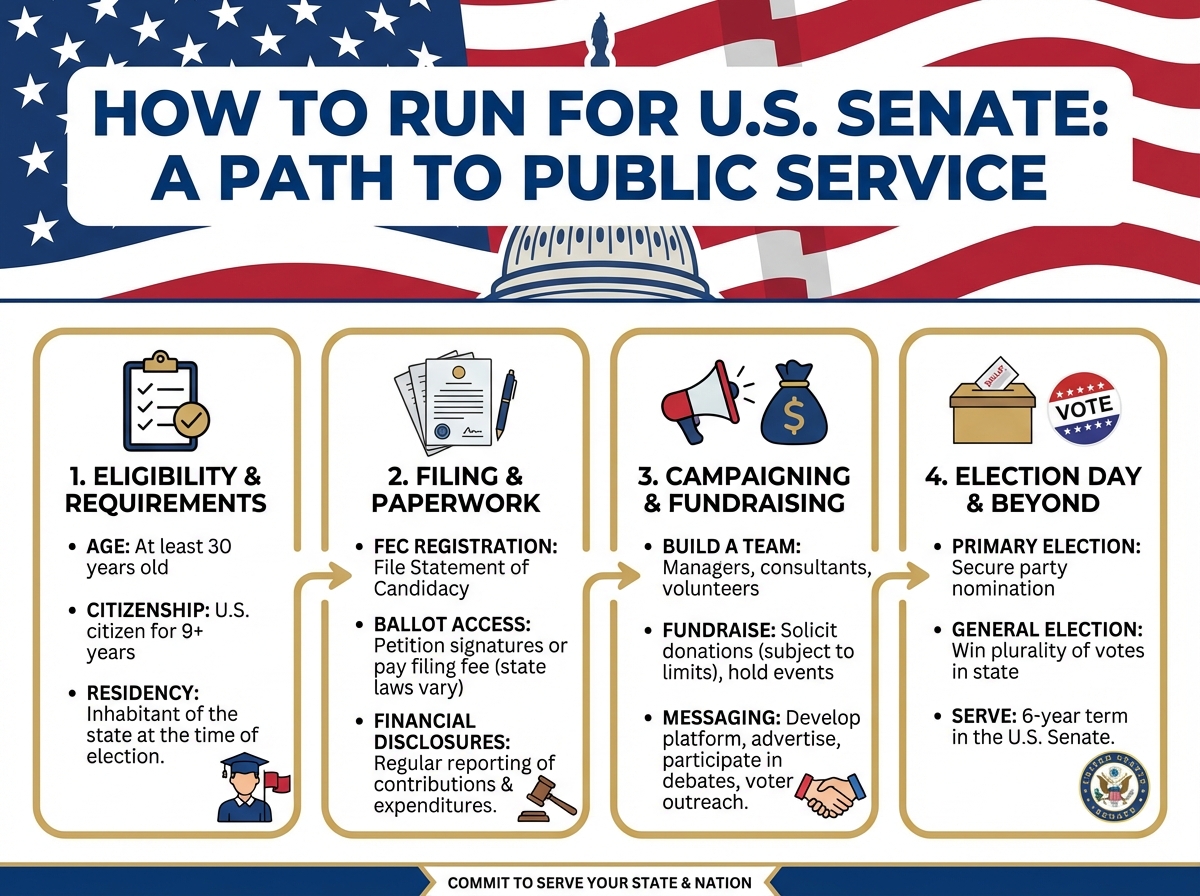
Infographic explaining how to run for U.S. Senate, including eligibility requirements, filing procedures, campaigning steps, fundraising, and the path through the primary and general elections.
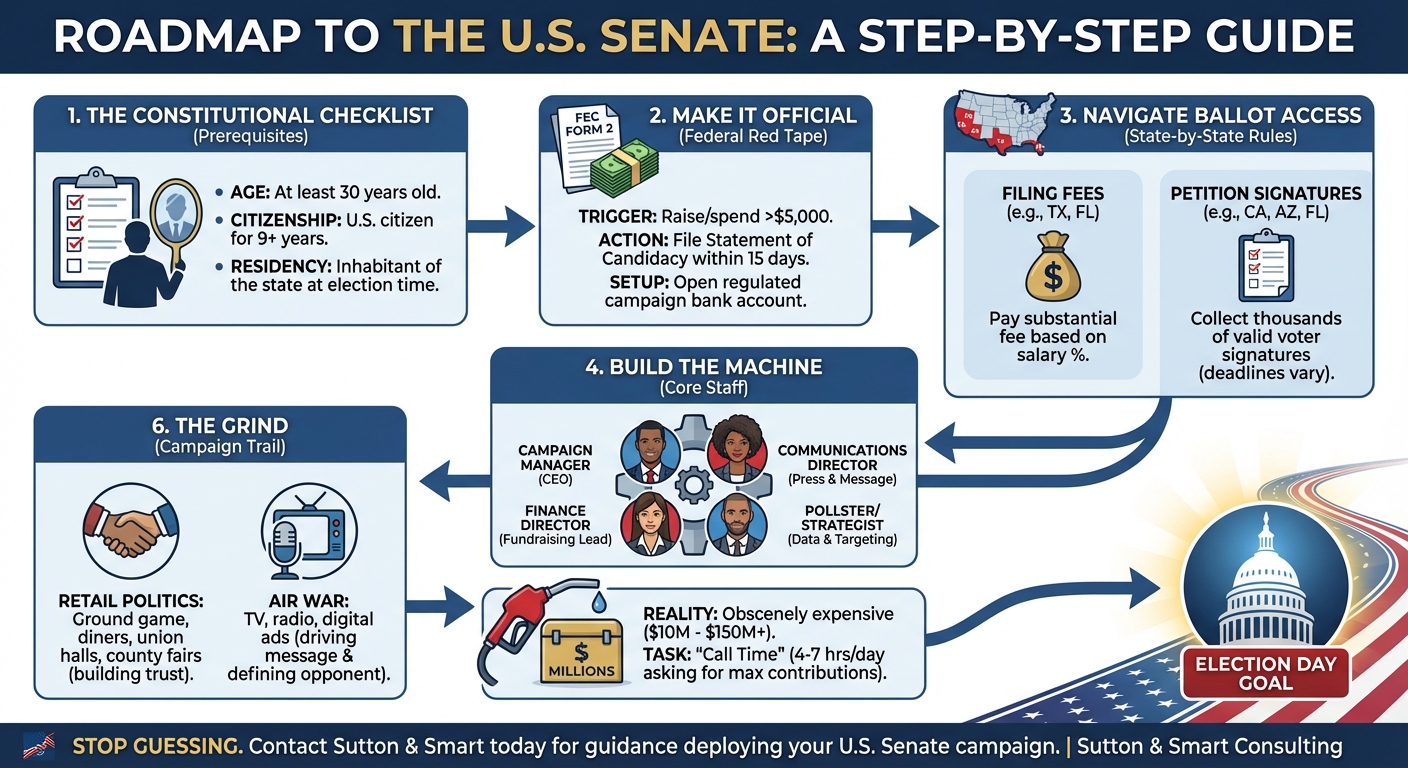
Infographic titled ‘Roadmap to the U.S. Senate’ showing the step-by-step process to run: constitutional requirements, FEC filing, ballot access, building staff, fundraising, and the campaign trail.

Step 1: The Mirror Test (Before You Start)

Before you hire a single staffer, print a bumper sticker, or whisper your intentions to a donor, you need to have a very honest, perhaps painful, conversation with yourself and your family.

The Constitutional Checklist
Let’s get the baseline legal requirements out of the way first. To be eligible to serve as a U.S. Senator, the Constitution mandates three things. You must be:

– At least 30 years old.

– A U.S. citizen for at least nine years prior to being elected.

– An inhabitant of the state you seek to represent at the time of the election.

The “Why” Narrative

Voters can smell inauthenticity from a mile away. “I want to make a difference” is too vague for a Senate race. You need a compelling, specific narrative that connects your personal biography to the acute needs of your state at this exact moment in time. What is the burning issue that only you can fix? Why are you running now? Your rationale needs to be sturdy enough to withstand thousands of interviews and debates.

The Opposition Research Reality Check

Are you truly ready for the microscope? Opposition research is a massive industry. Your entire life—past finances, old relationships, awkward photos from college, failed business ventures, and decades-old social media posts—will be scrutinized by professionals paid to destroy you. If your spouse and children aren’t enthusiastic about the inevitable attacks and loss of privacy, stop right here. The campaign trail is littered with candidates whose families collapsed under the pressure.

Step 2: Making It Official (The Red Tape & Ballot Access)

You cannot simply declare yourself a candidate on Twitter and call it a day. There are significant federal legal hurdles and complex state-level bureaucratic mazes to navigate.

The Federal Election Commission (FEC)

The federal government does not mess around with campaign finance. The moment you raise or spend an aggregate of $5,000 on your campaign activities (even just “testing the waters”), you are officially a candidate in the eyes of the law. Within 15 days of hitting that mark, you must file a “Statement of Candidacy” (Form 2) with the FEC. You also need to organize a campaign committee and open a dedicated, regulated bank account. Failing to comply with FEC strictures is the fastest way to accrue massive fines and ruin your reputation before you even start.

The State-by-State Reality Check: Ballot Access

While the FEC handles the money rules, your state’s Secretary of State handles getting your name physically printed on the ballot. Every state has vastly different election codes, filing deadlines, and signature requirements. Missing a deadline by an hour means you are not running.

To illustrate the diverse challenges of ballot access,
let’s look at four major political battlegrounds:

California (The Expensive Jungle): California utilizes a “Top-Two Candidates Open Primary.” All candidates, regardless of party, appear on one giant primary ballot. The top two vote-getters advance to November, even if they are two Democrats or two Republicans. To get on the ballot, you must either pay a filing fee equal to 2% of the Senate salary (thousands of dollars) or collect thousands of “in-lieu” signatures to waive it. The real barrier in CA, however, is the cost of communicating with 40 million people across massive media markets like Los Angeles and San Francisco.

Texas (The Tyranny of Geography): Everything is bigger in Texas, including the logistical nightmares. Running here means campaigning in multiple massive, distinct media markets simultaneously—Dallas-Fort Worth, Houston, Austin, San Antonio, and El Paso. Ballot access usually requires either a substantial filing fee (often around $5,000) or submitting petitions with upwards of 5,000 valid signatures from registered voters across the vast state.

Florida (The Media Market Mosaic): Florida is renowned for its high cost of entry due to expensive, fractured media markets ranging from Miami to the Panhandle. Ballot access here is very strict on deadlines. You generally qualify by paying a qualifying fee (usually a percentage of the office’s salary) or by using the petition method, which requires obtaining signatures equal to 1% of the total registered voters in the state from the last general election—a massive, expensive undertaking requiring paid canvassers.

Arizona (The National Spotlight State): While smaller in population, Arizona is currently ground zero for national political battles. The signature requirements to get on the ballot are generally lower than in CA or FL, making initial entry slightly easier. However, the political barrier is immense. Because it is a hyper-competitive swing state, national PACs flood the zone with money early. A candidate needs significant resources immediately to define themselves before millions of dollars in negative attack ads define them first.
Step 3: Building the Machine (Your Professional Staff)

You cannot run a Senate race with volunteers and well-meaning relatives. While your cousin might be good at Instagram, a statewide federal race requires experienced mercenaries.

Your core professional team must include:

Campaign Manager: The CEO of the operation. They manage the multi-million dollar budget, the grueling schedule, the staff, and make the final strategic calls. They are the barrier between the candidate and chaos.

Finance Director:
Perhaps your most vital staffer. Their sole job is to ensure money is flowing into the bank account every single day so the lights stay on and TV ads stay up.

Communications Director: Handles the aggressive press corps, frames your daily message, and puts out fires when you inevitably say something clunky.

General Consultant/Pollster: The high-level political strategist who uses quantitative data to tell you exactly which sliver of the electorate you need to target and precisely what messages will move them.

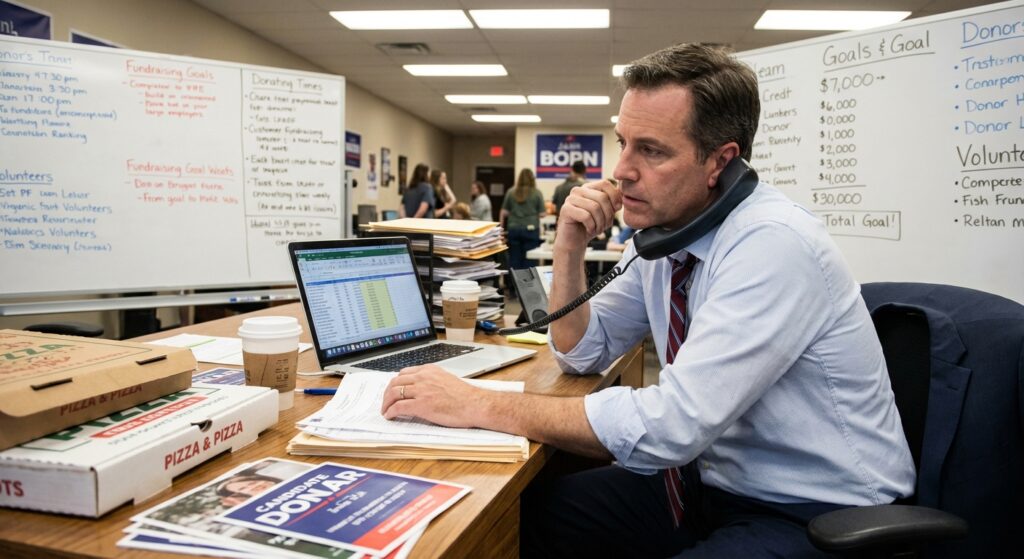
Political candidate making fundraising calls inside a busy campaign office, with spreadsheets, donor lists, whiteboards of goals, and volunteers working in the background.

Step 4: The Fuel (The Brutal Reality of Fundraising)

There is no polite way to say this: U.S. Senate races are obscenely expensive. Depending on the size of your state and how competitive the race is, winning can cost anywhere from: Drum roll…

$10 million to over $150 million.

Unless you are personally wealthy enough to self-fund, your primary job as a candidate is not kissing babies or debating policy. It is “call time.” You will likely be locked in a small room for 4 to 7 hours a day, staring at a spreadsheet of names, calling potential donors, and asking them for the maximum allowable contribution ($3,300 per election cycle as of 2025). It is grueling, humbling, and repetitive. If you despise asking strangers for money, you will despise running and fundraising for Senate. 

Step 6: The Grind (The Campaign Trail)

A Senate campaign is an endurance sport that blends old-school “retail politics” with modern “air wars.”
Retail Politics: This is the ground game. It’s shaking hands at rural diners at 6 AM, sweating through speeches at union halls, eating fried food at county fairs, and looking people in the eye. Voters still need to feel they have taken the measure of you personally before they trust you with a Senate seat.

The Air War: This is TV, radio, and digital advertising. It’s how you reach the millions of voters you will never meet in person. It is expensive, increasingly negative, and absolutely necessary in modern campaigning to drive home your narrative and define your opponent.

The Final Word

Running for the U.S. Senate is grueling. It will take a toll on your health, your finances, and your relationships. You will miss birthdays, anniversaries, and funerals. You will be attacked unfairly and constantly.
But if you have a genuine desire to serve, a thick skin, and a message that meets the historical moment, it is the highest level of civic engagement. Go in with your eyes wide open, hire the best professionals you can find, and never forget the core reason why you started this journey.

Considering Running For U.S. Senate As A Democrat?

Our team has helped strategize for congressional candidates, governors, and senators. Contact Sutton & Smart today for guidance on deploying your U.S. Senate campaign.

Ready to launch a winning campaign? Let Sutton & Smart political consulting help you maximize your budget, raise a bigger war chest, and reach more voters.

Jon Sutton

An expert in management, strategy, and field organizing, Jon has been a frequent commentator in national publications.

AutoAuthor | Partner

Have Questions?

Frequently Asked Questions

Should we support a 'Robot Tax' in our platform?

Proceed with caution. While popular with the progressive base, the term 'Robot Tax' can be easily weaponized by the GOP as anti-innovation. Instead, frame it as 'Automation Equity' or ensuring corporations pay their fair share when they replace payroll taxes with software costs.

How does this narrative fit with the Biden-Harris AI executive orders?

Lean into the White House's 'AI Bill of Rights' framework. It provides a solid federal floor for your arguments. promoting that Democrats are the only ones actually doing the work to ensure safety while the GOP offers chaos.

Is this issue relevant for State House or Senate races?

Absolutely. State legislatures control how AI is used in state government, unemployment processing, and policing. Running on 'Algorithmic Justice' in state services is a powerful local angle.

Get In Touch

Ready to Win? Reach Out Below.

Disclaimer: This blog post provides a general overview and should not be taken as specific legal advice. Election laws, particularly regarding ballot access and campaign finance compliance, are incredibly complex, state-specific, and subject to frequent change. Always consult with experienced election law attorneys and compliance professionals when establishing a campaign. This article is provided for educational and informational purposes only and does not constitute legal, financial, or tax advice. Political campaign laws, FEC regulations, voter-file handling rules, and platform policies (Meta, Google, etc.) are subject to frequent change. State-level laws governing the use, storage, and transmission of voter files or personally identifiable political data vary significantly and may impose strict limitations on third-party uploads, data matching, or cross-platform activation. Always consult your campaign’s General Counsel, Compliance Treasurer, or state party data governance office before making strategic, legal, or financial decisions related to voter data. Parts of this article may have been created, drafted, or refined using artificial intelligence tools. AI systems can produce errors or outdated information, so all content should be independently verified before use in any official campaign capacity. Sutton & Smart is an independent political consulting firm. Unless explicitly stated, we are not affiliated with, endorsed by, or sponsored by any third-party platforms mentioned in this content, including but not limited to NGP VAN, ActBlue, Meta (Facebook/Instagram), Google, Hyros, or Vibe.co. All trademarks and brand names belong to their respective owners and are used solely for descriptive and educational purposes.

Please Note: Governmental websites, particularly state election divisions, frequently update their URLs and guidance documents for each election cycle. The links below lead to the primary pages governing candidate information as of late 2023/late 2025.

Federal Legal Requirements & Campaign Finance
1. U.S. Constitutional Requirements for Senators (Article I, Section 3, Clause 3)

Relevance: Establishes the age (30), citizenship (9 years), and residency requirements.

Source URL (National Archives):
https://www.archives.gov/founding-docs/constitution-transcript

2. Federal Election Commission (FEC): Candidate Status Trigger

Relevance: Explains that raising or spending over $5,000 triggers official candidate status and requires filing Form 2.

Source URL (FEC):
https://www.fec.gov/help-candidates-and-committees/candidate-taking-steps/

3. Federal Election Commission (FEC): Contribution Limits (2023-2024 Cycle)

Relevance: Sourced the specific individual contribution limit mentioned in the blog ($3,300 per election for the 2024 cycle).

Source URL (FEC):
https://www.fec.gov/help-candidates-and-committees/candidate-taking-receipts/contribution-limits/

State-Specific Ballot Access Examples
4. California Secretary of State: Candidate Information

Relevance: Details California’s “Top-Two” primary system and the requirements for filing fees and signatures-in-lieu-of-filing-fees.

Source URL (CA SOS Election Division):
https://www.sos.ca.gov/elections/candidate-info

5. Texas Secretary of State: Candidate Information Guide

Relevance: Outlines the requirements for primary ballot access in Texas, including filing fees or petition signature options for federal office.

Source URL (TX SOS Elections Division):
https://www.sos.state.tx.us/elections/candidates/index.shtml

6. Florida Division of Elections: Qualifying for Office

Relevance: Explains Florida’s dual methods for qualifying: paying a qualifying fee based on salary percentage or the petition method requiring 1% of registered voters.

Source URL (FL Department of State):
https://dos.myflorida.com/elections/candidates-committees/qualifying/

7. Arizona Secretary of State: Running for Federal Office

Relevance: Provides guidance on partisan nomination procedures and signature requirements for U.S. Senate candidates in Arizona.

Source URL (AZ SOS):
https://azsos.gov/elections/running-public-office/running-federal-office

Leave a Comment

Your email address will not be published. Required fields are marked *

Scroll to Top

View All Brands

Fill out the form to view all Sutton & Smart Brands.

By submitting this form, you consent to allow Sutton & Smart to store and process your information in accordance with our Privacy Policy. You also consent to receive communications via email, phone, or SMS from Sutton & Smart regarding our services, including promotional offers and inquiries. These communications may be generated using automated technology, such as AI-powered autodialers, pre-recorded messages, and SMS notifications. Your information will be used strictly for business purposes, and you may opt out of these communications at any time. By clicking submit, you acknowledge that the effectiveness of Sutton & Smart’s political consulting strategies and outcomes may vary based on numerous factors outside our control, and no specific results or timelines are guaranteed. You also confirm that you have read and agree to our Terms of Service.

Work With Us

Fill out the form below to speak with someone from our team.

By submitting this form, you consent to allow Sutton & Smart to store and process your information in accordance with our Privacy Policy. You also consent to receive communications via email, phone, or SMS from Sutton & Smart regarding our services, including promotional offers and inquiries. These communications may be generated using automated technology, such as AI-powered autodialers, pre-recorded messages, and SMS notifications. Your information will be used strictly for business purposes, and you may opt out of these communications at any time. By clicking submit, you acknowledge that the effectiveness of Sutton & Smart’s political consulting strategies and outcomes may vary based on numerous factors outside our control, and no specific results or timelines are guaranteed. You also confirm that you have read and agree to our Terms of Service.