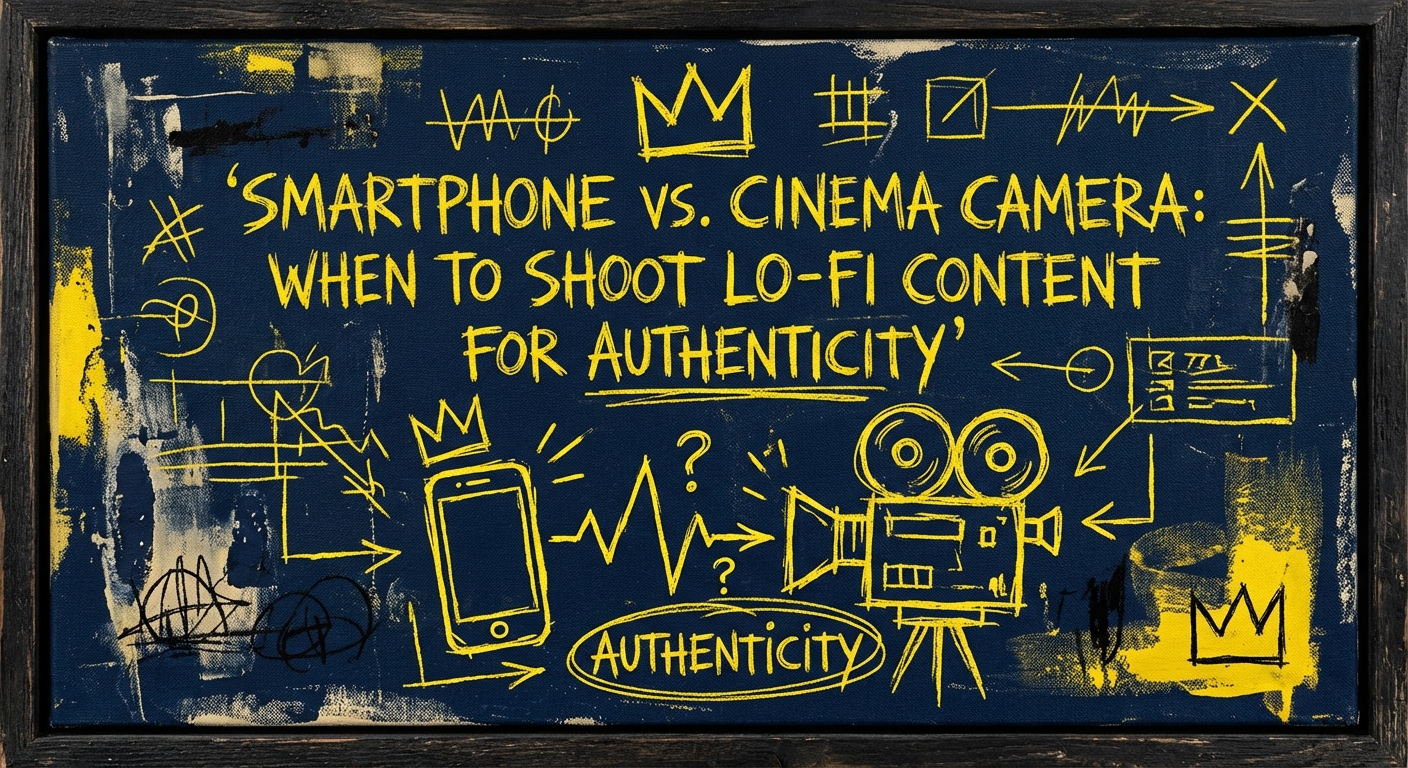
Smartphone vs. Cinema Camera: When to Shoot Lo-Fi Content for Authenticity
Understanding the precise trade-off regarding Smartphone vs. Cinema Camera: When to Shoot Lo-Fi Content for Authenticity is the difference between a viral moment and a forgotten ad in today’s rapid-response political landscape. The Republican machine often relies on slick, over-produced messaging funded by dark money, which can feel sterile and disconnected to the average voter. Conversely, the Democratic base thrives on human connection, grassroots energy, and truth. As a campaign strategist, you must master the art of selecting the right tool for the right moment. It is not just about pixel count; it is about the psychological impact of the medium. A high-end cinema rig signals authority, but it creates distance. A smartphone signals immediacy and intimacy, but it can lack gravitas. In this guide, we will break down exactly when to deploy each asset to secure the narrative and win the vote.
Smartphone vs. Cinema Camera: When to Shoot Lo-Fi Content for Authenticity on the Campaign Trail
Before we debate the hardware, we must establish the strategic criteria for Democratic storytelling. We do not choose cameras based on megapixels; we choose them based on emotional resonance and logistical agility. The first criterion is Speed to Market. When a GOP opponent makes a gaffe or a policy disaster unfolds, waiting three days for a color-graded cinema edit is political malpractice. The second criterion is Relatability. Voters are skeptical of polished politicians. They trust content that feels raw, unscripted, and close to the ground—often called the ‘User Generated Content’ (UGC) aesthetic. The third criterion is Authority. There are moments, such as a biographical launch video or a sombre address regarding reproductive rights, where cinematic depth of field and dynamic range are non-negotiable to convey seriousness. Your media mix should not be a binary choice but a tactical deployment based on the specific emotional goal of the content piece.
The Case for Smartphones: Weaponizing Authenticity and Speed
Smartphones are the ultimate tool for lo-fi content that builds trust through perceived transparency. With a price point of $500 to $1,500, essentially zero marginal cost, and no setup time, they allow your candidate to capitalize on the 24-hour news cycle instantly. This is the domain of ‘sousveillance’—the ability to document rallies, protests, and candid backstage moments discreetly and authentically. When you shoot on an iPhone 15 Pro or similar device, you are speaking the native language of TikTok, Instagram Reels, and Shorts. The lower fidelity, or ‘lo-fi’ look, signals to the viewer that ‘this is happening right now’ and ‘this is real.’ It breaks down the fourth wall. For rapidly mobilizing the base or reacting to breaking news, the smartphone is superior because it removes the barrier between the candidate and the voter. A shaky, vertical video of a candidate speaking passionately to a union worker often outperforms a $50,000 TV spot on social platforms because it feels unmanufactured. Use smartphones for day-in-the-life vlogs, rapid response to opponent attacks, and mobilizing ‘Get Out The Vote’ (GOTV) efforts where urgency beats aesthetics.
The Case for Cinema Cameras: Establishing Authority and Credibility
While smartphones win on speed, cinema cameras ($5,000 to $50,000+) are the heavy artillery for establishing high-level credibility. When you are introducing a candidate to the district for the first time, or airing a spot on broadcast television during the evening news, image quality equates to electability. Cinema cameras offer superior dynamic range, low-light performance, and that distinct depth of field that separates the subject from the background, focusing the voter’s attention entirely on the message. This gear is essential for ‘Hero’ content: launch videos, policy deep-dives, and televised attack ads that need to cut through the noise with professional weight. Unlike smartphones, these cameras do not integrate directly with social apps; they require a professional workflow involving lenses, lighting crews, and post-production color grading. This lack of agility is the trade-off for an image that commands respect. You use this tool when you need to look like a statesman or stateswoman who is ready to govern, not just a campaigner looking for likes.
The Strategic Balance: The 80/20 Rule of Content
The most effective Democratic campaigns today utilize a hybrid model. We often recommend an 80/20 split: 80% of your daily content output should be shot on smartphones to feed the algorithmic beast of social media, while the top 20%—your ‘tentpole’ assets—should be shot on cinema cameras. This structure ensures you stay relevant in the daily conversation without blowing your budget on fleeting moments, while still retaining the firepower for high-stakes media buys. Do not confuse the two lanes. Using a cinema camera for a quick TikTok trend looks out of touch and ‘boomer-ish,’ effectively killing the vibe. Conversely, using a smartphone for a broadcast TV commercial about protecting democracy can look amateurish and under-funded unless the grainy aesthetic is a deliberate creative choice. Knowing Smartphone vs. Cinema Camera: When to Shoot Lo-Fi Content for Authenticity means understanding that ‘lo-fi’ is for connection and ‘hi-fi’ is for conviction.
The Verdict: Selecting the Right Gear for the Mission
To wrap up, your decision should always follow the strategic objective of the specific piece of content. If your goal is authenticity, speed, and social engagement, the smartphone is the clear winner. It allows for discreet filming, integrates instantly with apps, and costs almost nothing to deploy. If your goal is to build long-term authority, project leadership, and compete on broadcast television, you must invest in cinema cameras and the crew to operate them. A winning campaign does not choose one over the other; it builds a media ecosystem that leverages the strengths of both. By maintaining this discipline, you ensure that your campaign remains agile enough to fight the daily battles while robust enough to win the war.
The Sutton & Smart Difference: Full-Stack Media Infrastructure
Capturing the footage is only the first step; ensuring it persuades the right voters in the critical swing districts is where elections are won. At Sutton & Smart, we specialize in taking your content—whether shot on an iPhone or an ARRI Alexa—and weaponizing it through our Democratic Media Buying and Rapid Response Digital Ads divisions. We don’t just post videos; we use advanced voter file targeting to ensure your lo-fi authenticity reaches the exact undecided voters who need to see it, while your cinematic TV spots saturate the airwaves to demoralize the GOP opposition. We provide the full-stack infrastructure, from Anti-Disinformation Units to 48-hour emergency production, ensuring your message survives the Republican noise machine. Stop hoping your content goes viral and start building the logistical pipeline that guarantees it creates a Blue Wave.
Ready to Dominate the Narrative?
Contact Sutton & Smart today to upgrade your campaign’s media strategy and secure the specialized support needed to win.
Ready to launch a winning campaign? Let Sutton & Smart political consulting help you maximize your budget, raise a bigger war chest, and reach more voters.
Jon Sutton
An expert in management, strategy, and field organizing, Jon has been a frequent commentator in national publications.
Generally, no. While modern phones shoot 4K, the compression and sensor size often fall apart on large broadcast screens. However, clips of smartphone footage can be included within a TV ad to show 'real' moments, provided they are framed correctly.
Do I need an external microphone for smartphone videos?
Absolutely. Bad audio is forgivable in no medium. Even for lo-fi content, using a small plug-in wireless mic ensures your candidate's message is heard clearly over crowd noise.
Is it worth renting a cinema camera instead of buying?
Yes. Political campaigns are temporary entities. Renting high-end gear for specific shoot days is far more budget-efficient than purchasing depreciating assets, allowing you to allocate more funds to field operations.
This article is provided for educational and informational purposes only and does not constitute legal, financial, or tax advice. Political campaign laws, FEC regulations, voter-file handling rules, and platform policies (Meta, Google, etc.) are subject to frequent change. State-level laws governing the use, storage, and transmission of voter files or personally identifiable political data vary significantly and may impose strict limitations on third-party uploads, data matching, or cross-platform activation. Always consult your campaign’s General Counsel, Compliance Treasurer, or state party data governance office before making strategic, legal, or financial decisions related to voter data. This material is provided for general guidance only and should be independently verified before use in any official campaign capacity. Sutton & Smart is an independent political consulting firm. Unless explicitly stated, we are not affiliated with, endorsed by, or sponsored by any third-party platforms mentioned in this content, including but not limited to NGP VAN, ActBlue, Meta (Facebook/Instagram), Google, Hyros, or Vibe.co. All trademarks and brand names belong to their respective owners and are used solely for descriptive and educational purposes.
Get more of our political coverage in your Google results:
Scroll to Top
View All Brands
Fill out the form to view all Sutton & Smart Brands.
By submitting this form, you consent to allow Sutton & Smart to store and process your information in accordance with our
Privacy Policy.
You also consent to receive communications via email, phone, or SMS from Sutton & Smart regarding our services, including promotional offers and inquiries.
These communications may be generated using automated technology, such as AI-powered autodialers, pre-recorded messages, and SMS notifications.
Your information will be used strictly for business purposes, and you may opt out of these communications at any time.
By clicking submit, you acknowledge that the effectiveness of Sutton & Smart’s political consulting strategies and outcomes may vary based on numerous factors outside our control, and no specific results or timelines are guaranteed.
You also confirm that you have read and agree to our
Terms of Service.
Work With Us
Fill out the form below to speak with someone from our team.
By submitting this form, you consent to allow Sutton & Smart to store and process your information in accordance with our
Privacy Policy.
You also consent to receive communications via email, phone, or SMS from Sutton & Smart regarding our services, including promotional offers and inquiries.
These communications may be generated using automated technology, such as AI-powered autodialers, pre-recorded messages, and SMS notifications.
Your information will be used strictly for business purposes, and you may opt out of these communications at any time.
By clicking submit, you acknowledge that the effectiveness of Sutton & Smart’s political consulting strategies and outcomes may vary based on numerous factors outside our control, and no specific results or timelines are guaranteed.
You also confirm that you have read and agree to our
Terms of Service.